80th Independence Day 2026: History, Wishes, Quotes and 15 August Facts
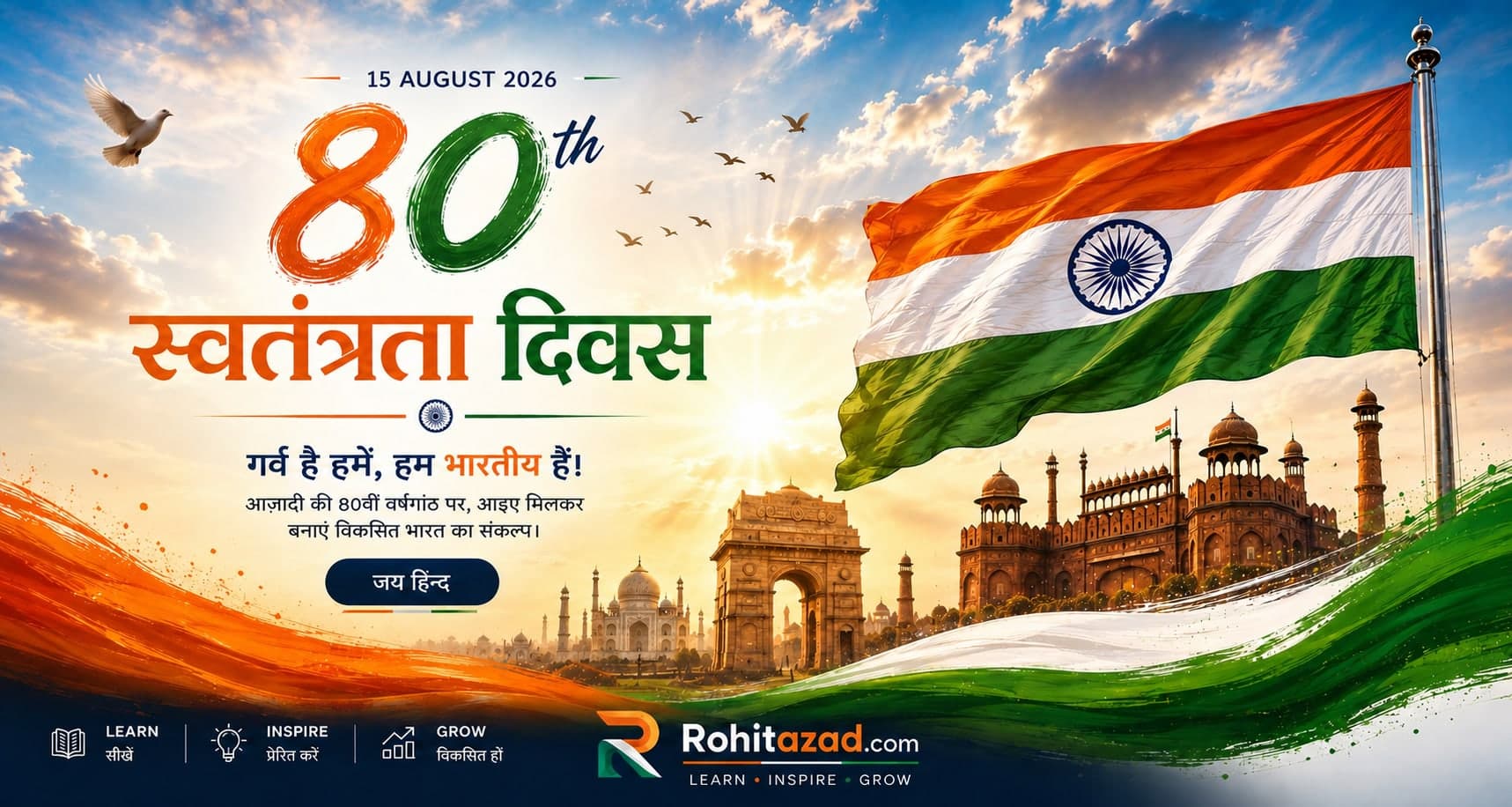
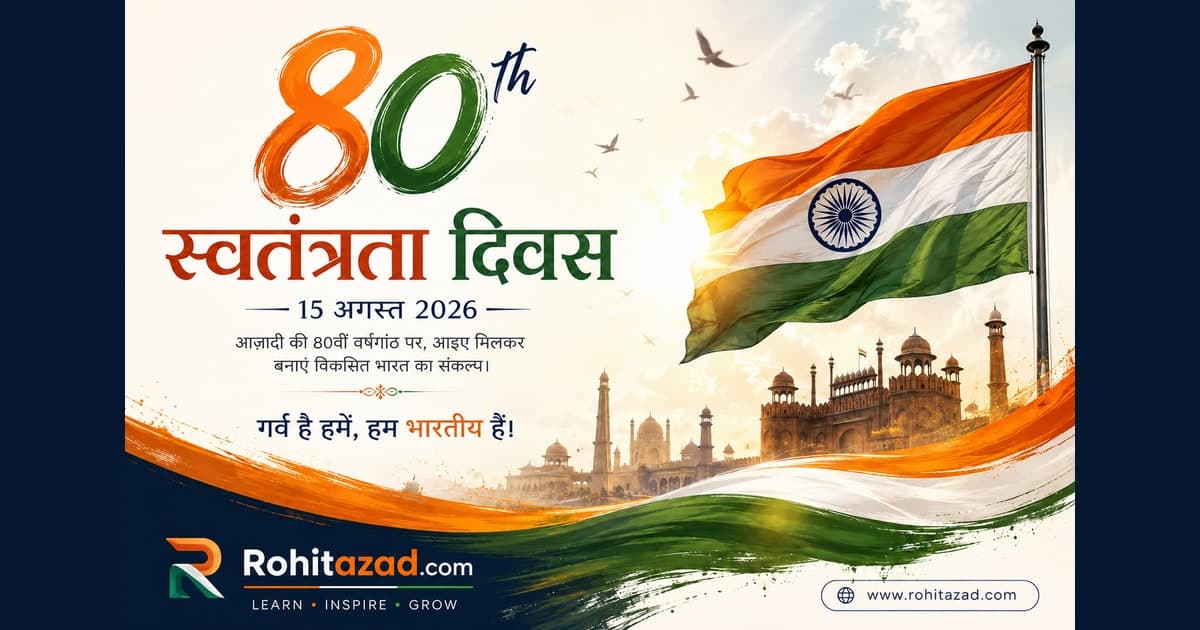
80वां
India celebrates its 80th Independence Day on Saturday, 15 August 2026—marking 79 completed years since independence on 15 August 1947.
Read the verified story ↓The meaning of the day
A freedom won.
A responsibility renewed.
At midnight between 14 and 15 August 1947, India emerged from British colonial rule as an independent nation.
Independence Day remembers the long, diverse freedom struggle and the countless people who participated in it. It is also a day to renew the democratic values of liberty, equality, unity and service.
80th day, 79 completed years—why?
The first Independence Day was observed in 1947. Counting that as the first observance makes 2026 the 80th Independence Day, while the elapsed time from 1947 to 2026 is 79 years.
A short timeline
Milestones of freedom
- The Tricolour is adopted
The Constituent Assembly adopted the National Flag in its present form.
- India becomes independent
Colonial rule ended and India began its journey as a sovereign nation.
- India becomes a republic
The Constitution came into effect—this is commemorated separately as Republic Day.
- The 80th observance
India completes 79 years of independence and celebrates its 80th Independence Day.
Verified leadership milestone · 10 June 2026
Narendra Modi’s record of continuous elected service
The Union Cabinet recorded that Prime Minister Narendra Modi became India’s longest continuously serving elected Prime Minister on 10 June 2026.
Read the official PMO resolution ↗Record reached4,399continuous daysas an elected Prime Minister
on 10 June 2026
on 10 June 2026
What the record means
It measures uninterrupted service through consecutive elected mandates. The official comparison is Modi’s 4,399 days from 2014 against Nehru’s 4,398-day elected-PM sequence from 1952 to 1964.
Historical context
Jawaharlal Nehru’s complete tenure began on 15 August 1947 and ended on 27 May 1964, so Nehru still has the longer total elapsed tenure when the pre-1952 period is included.
नरेंद्र मोदीPrime Minister Narendra ModiA concise, source-checked public-service timeline
- Born in Vadnagar
Born on 17 September 1950 in Vadnagar, Gujarat; the first Indian Prime Minister born after independence.
- Chief Minister of Gujarat
Served for approximately 13 years before moving to national office.
- First term as Prime Minister
Took the oath of office after the 2014 parliamentary election.
- Third consecutive term
Was sworn in as Prime Minister for the third time.
- Continuous elected-service milestone
The Cabinet recognised the 4,399-day record.
Initiatives cited in the 2026 Cabinet resolution
India hosted the G20 presidency and New Delhi Leaders’ Summit in 2023.
The UN-designated observance has been held annually since 2015.
A global cooperation platform focused on solar-energy deployment.
A public initiative promoting environmentally conscious lifestyles.
Editorial standard: This section distinguishes the official continuous elected-service record from total historical tenure. Biographical and milestone claims are linked to PMO records and were last checked on 14 August 2026.
Leaders of independent India
From the first Prime Minister to today
India has had 15 individual Prime Ministers since 1947 when Gulzarilal Nanda—who served twice in an acting capacity—is included. Leaders returning for another term are counted once.
First Prime MinisterJawaharlal Nehru15 August 1947 – 27 May 1964
Current Prime Minister · verified August 2026Narendra ModiIn office since 26 May 2014 · third term from 9 June 2024
First PresidentDr. Rajendra Prasad
26 Jan 1950 – 13 May 1962
Current PresidentDroupadi Murmu
In office since 25 Jul 2022
First woman Prime MinisterIndira Gandhi
First took office 24 Jan 1966
Jawaharlal Nehru15 Aug 1947 – 27 May 1964India’s first Prime Minister
Gulzarilal NandaActing: 1964 and 1966Served twice as acting Prime Minister
Lal Bahadur Shastri9 Jun 1964 – 11 Jan 1966
Indira Gandhi1966–1977; 1980–1984India’s first woman Prime Minister
Morarji Desai24 Mar 1977 – 28 Jul 1979
Charan Singh28 Jul 1979 – 14 Jan 1980
Rajiv Gandhi31 Oct 1984 – 2 Dec 1989Youngest Prime Minister, aged 40
V. P. Singh2 Dec 1989 – 10 Nov 1990
Chandra Shekhar10 Nov 1990 – 21 Jun 1991
P. V. Narasimha Rao21 Jun 1991 – 16 May 1996
Atal Bihari Vajpayee1996; 1998–2004
H. D. Deve Gowda1 Jun 1996 – 21 Apr 1997
I. K. Gujral21 Apr 1997 – 19 Mar 1998
Dr. Manmohan Singh22 May 2004 – 26 May 2014
Narendra Modi26 May 2014 – presentCurrent Prime Minister · third term began 9 Jun 2024
Count method: 15 distinct people, including acting Prime Minister Gulzarilal Nanda; repeat terms are grouped under the same person.
Our national flag
Three colours.
One India.
The flag has a width-to-length ratio of 2:3 and a navy-blue Ashoka Chakra with 24 spokes at its centre.
Saffron
Strength and courage
White
Peace and truth
Green
Fertility, growth and auspiciousness
Ashoka Chakra
The wheel of law and movement
Voices of the freedom struggle
Leaders remembered across generations
India’s freedom movement included millions of people, organisations and regional struggles. This compact list is representative, not exhaustive.
Mahatma Gandhi
Led mass movements grounded in satyagraha and non-violence.
Subhas Chandra Bose
Led the Indian National Army and advocated complete independence.
Bhagat Singh
Revolutionary remembered for courage, sacrifice and anti-colonial resistance.
Sardar Vallabhbhai Patel
Freedom movement leader who later helped integrate the princely states.
Jawaharlal Nehru
Freedom movement leader and independent India’s first Prime Minister.
Chandrashekhar Azad
Revolutionary organiser who resisted British colonial rule.
Rani Lakshmibai
Queen of Jhansi and a leading figure in the uprising of 1857.
Shareable messages for 15 August
80th Independence Day wishes and original quotes
Short, original messages written for respectful personal sharing in 2026.
A national tradition
How India celebrates Independence Day
Practices vary across states, schools, institutions and communities, while the national ceremony takes place in Delhi.
Red Fort ceremony
The Prime Minister unfurls the National Flag and delivers the customary address from the Red Fort.
Flag ceremonies
Government offices, schools, residential communities and institutions hold respectful flag ceremonies.
Cultural programmes
Students and communities present speeches, exhibitions and performances reflecting India’s history and diversity.
Citizen participation
Official campaigns, educational activities and community service invite people to connect freedom with civic responsibility.
Observe with meaning
Celebrate with pride and respect
Honour the flag
Display the Tricolour with dignity and follow the Flag Code of India and applicable law.
Remember the struggle
Read verified histories, listen to family memories and honour freedom fighters from every part of India.
Serve your community
Volunteer, help a neighbour, plant a native tree or contribute to a cleaner shared space.
Live the values
Practise respect, inclusion, responsibility and unity in everyday civic life.
At the national celebration, the Prime Minister traditionally hoists the Tricolour at Delhi’s Red Fort and addresses the nation. The President traditionally addresses the nation on the eve of Independence Day.
“I will honour India’s freedom through responsible action, respect for others, care for our shared heritage and service to my community.”
जय हिन्द · Jai HindQuick answers
Independence Day 2026 FAQ
Which Independence Day will India celebrate in 2026?
India will celebrate its 80th Independence Day on 15 August 2026. The country attained independence on 15 August 1947, so 79 years will have been completed.
Why is it the 80th Independence Day if India completes 79 years?
The observance in 1947 is counted as the first Independence Day. Therefore 2026 is the 80th observance, while the elapsed time between 15 August 1947 and 15 August 2026 is 79 full years.
When is India's Independence Day in 2026?
India's Independence Day falls on Saturday, 15 August 2026.
Why is Independence Day celebrated on 15 August?
India became independent from British colonial rule on 15 August 1947. The date is observed every year to remember the freedom struggle and honour those who contributed to it.
Is Independence Day the same as Republic Day?
No. Independence Day marks freedom from colonial rule on 15 August 1947. Republic Day marks the Constitution of India coming into effect on 26 January 1950.
Who unfurls the national flag at the Red Fort on Independence Day?
The Prime Minister of India traditionally unfurls the national flag at Delhi's Red Fort and addresses the nation on 15 August.
What does the Indian Tricolour represent?
The National Portal of India describes saffron as strength and courage, white as peace and truth, and green as fertility, growth and auspiciousness. The navy-blue Ashoka Chakra has 24 spokes and represents movement and the wheel of law.
What is the theme of Independence Day 2026?
The official MyGov Independence Day Celebrations 2026 campaign uses the heading 'Honouring Freedom, Inspiring the Future'. Individual government competitions have separate themes, so this page does not present a different single nationwide theme without an official announcement.
How can we celebrate Independence Day responsibly?
Respect the Flag Code of India, avoid littering or disposable plastic decorations, learn from reliable historical sources, include people respectfully and contribute through community service.
Who is the Prime Minister of India in 2026?
Narendra Modi is the Prime Minister of India as of August 2026. He first took office on 26 May 2014 and was sworn in for a third consecutive term on 9 June 2024.
Is Narendra Modi India's longest-serving Prime Minister?
On 10 June 2026, Narendra Modi became India's longest continuously serving elected Prime Minister, reaching 4,399 days and passing Jawaharlal Nehru's 4,398-day elected-PM sequence counted from 1952. Nehru's complete tenure from 15 August 1947 to 27 May 1964 remains longer in total elapsed time.
Who was the first Prime Minister of India?
Jawaharlal Nehru was independent India's first Prime Minister. He served from 15 August 1947 until 27 May 1964.
Fact-check desk
Official sources
Claims on this page were checked against primary Government of India sources. Links open the original record.
- National Portal of IndiaIndependence Day information
- Know IndiaHistory and design of the Tricolour
- Ministry of Home AffairsFlag Code, advisories and FAQs
- Prime Minister of IndiaOfficial record confirming the preceding 79th observance
- PMO · Former Prime MinistersOfficial names and terms of office
- National Portal · Who’s WhoCurrent Prime Minister and national office holders
- President of IndiaOfficial record of India’s Presidents
- PMO · Cabinet resolution4,399-day continuous elected-service milestone
- PMO · Personal life storyBirth, public-service and governance timeline
- MyGov · Independence Day 2026Official campaign and citizen activities
Last updated: 14 August 2026 · Facts checked against the linked primary government records.